
Spot Buying vs Contract Buying in Mineral Supply
When sourcing industrial minerals, buyers usually rely on one of two procurement approaches: spot buying or contract buying. Both methods are common in the mineral trade, but each carries different risks, cost implications, and operational impacts.
Understanding the difference between spot and contract buying can help manufacturers, traders, and processors choose the right strategy based on their production needs and risk tolerance.
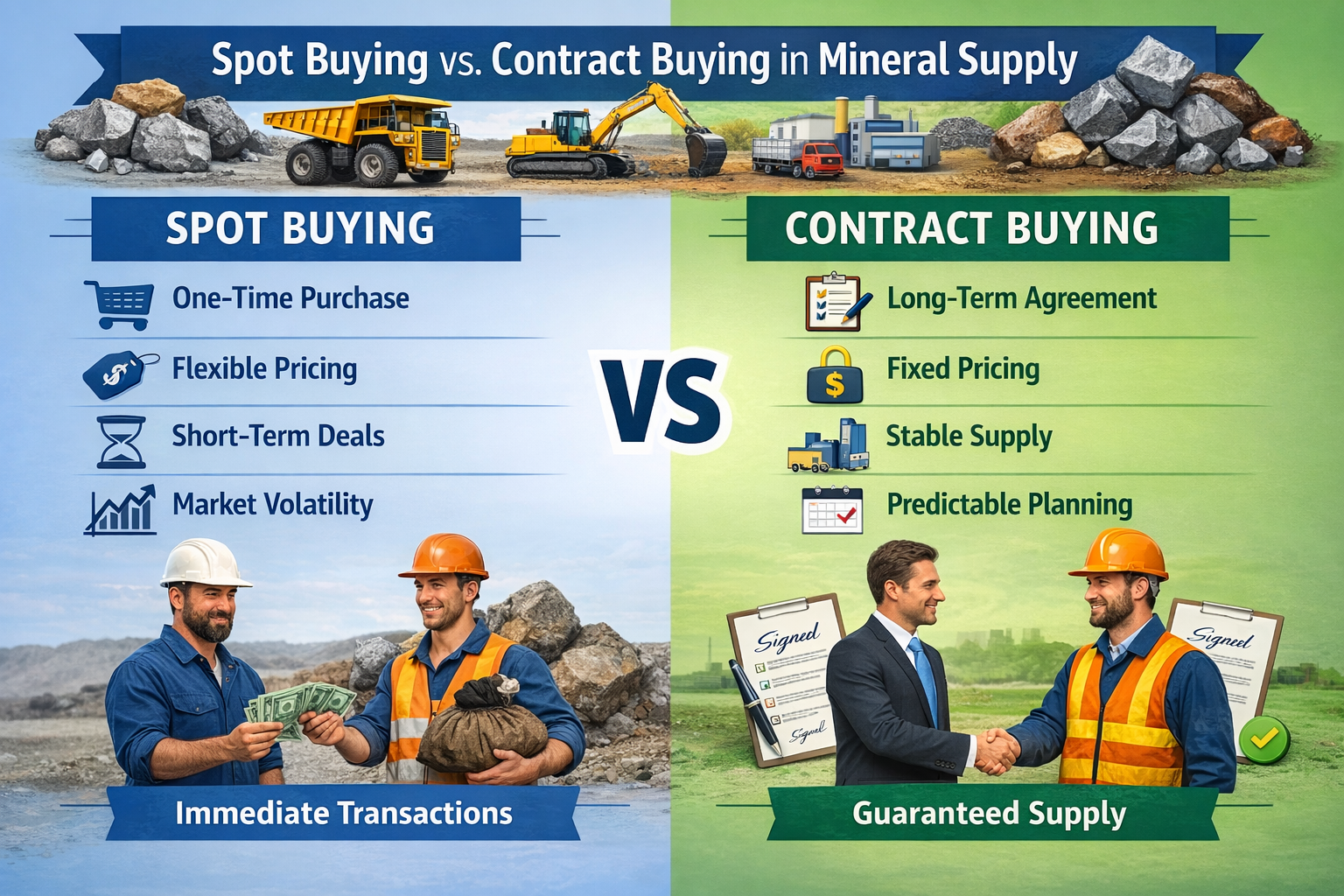
What is spot buying in mineral supply?
Spot buying refers to purchasing minerals on an immediate or short-term basis, often based on current market availability and pricing. These purchases are usually made when materials are required urgently or when buyers want to take advantage of short-term price drops.
- No long-term commitment
- Prices fluctuate with market conditions
- Limited predictability in supply and quality
Advantages of spot buying
Spot buying can be useful in specific situations where flexibility is more important than consistency.
- Immediate access to available stock
- Ability to benefit from short-term price reductions
- Useful for testing new suppliers or materials
Risks associated with spot buying
While spot buying may seem cost-effective, it often exposes buyers to higher operational risk.
Common risks: inconsistent quality, unpredictable delivery timelines, sudden price increases, and limited supplier accountability.
For production-dependent industries, these risks can result in downtime, quality issues, and planning disruptions.
What is contract buying in mineral supply?
Contract buying involves entering a long-term agreement with a supplier for regular mineral supply over a defined period. These contracts typically specify quality standards, pricing mechanisms, delivery schedules, and volume commitments.
- Fixed or semi-fixed pricing structure
- Guaranteed supply volumes
- Defined quality specifications
Benefits of contract buying
Contract buying is often preferred by manufacturers with stable and predictable demand.
- Consistent quality and specifications
- Improved production planning and forecasting
- Lower long-term procurement risk
- Stronger supplier accountability
When spot buying makes sense
Spot buying is suitable when demand is irregular, production volumes fluctuate, or market conditions are highly uncertain. It can also be useful for short-term requirements or emergency replenishment.
When contract buying is the better option
Contract buying is ideal for industries that rely heavily on continuous mineral supply, such as cement, ceramics, chemicals, and construction materials. Long-term agreements reduce uncertainty and protect against sudden market volatility.
Key takeaway
Spot buying offers flexibility, while contract buying provides stability. The right choice depends on your operational needs, risk tolerance, and production consistency. In many cases, businesses use a combination of both strategies to balance flexibility and security.
💬 FAQ
Is contract buying always cheaper than spot buying?
Not always, but it often reduces long-term costs by minimizing supply disruptions and price volatility.
Can small manufacturers use contract buying?
Yes. Even smaller buyers can benefit from short-term or volume-based contracts depending on supplier flexibility.
Does spot buying increase quality risk?
Yes. Spot purchases often lack consistent quality controls compared to contract-based supply.
Can both strategies be used together?
Yes. Many businesses use contracts for core supply and spot buying for additional or emergency needs.